


Extreme UAE summer heat can expose weak cooling systems, AC issues, batteries, tyres, brakes, belts, hoses, and fluids. Learn how HD Garage and HD TyrePlus help Dubai drivers prevent breakdowns before peak summer.
Summer driving in Dubai is demanding on every part of a vehicle. When temperatures climb above 40°C, weak components that seemed acceptable during cooler months can quickly become breakdown risks. Tyres operate on hotter road surfaces, batteries age faster, cooling systems work harder, and air-conditioning systems are pushed to their limit.
At HD Garage and HD TyrePlus, we see the same pattern every summer: most breakdowns do not start suddenly. They usually begin as small warning signs, such as a slightly weak battery, minor coolant leak, reduced AC cooling, tyre vibration, brake noise, or early cracks in hoses and belts. Under UAE summer conditions, these small issues can quickly become expensive repairs or uncomfortable roadside situations.
Our recommendation is simple: inspect the vehicle before peak summer, fix the real root cause, and avoid replacing parts unnecessarily. This diagnostics-first approach is especially important for 4x4s, SUVs, family cars, performance vehicles, and off-road vehicles that face higher heat, heavier loads, and more demanding driving conditions.
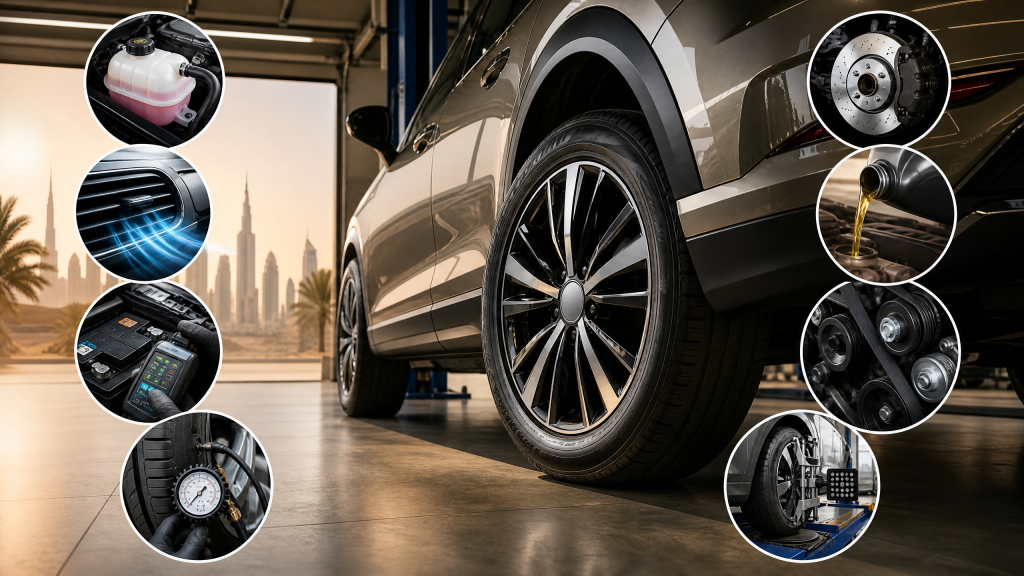
Top 5 Summer Car Problems in the UAE
1. Engine Overheating
Engine overheating is one of the most serious summer risks. A cooling system depends on correct coolant level, proper coolant circulation, a healthy radiator, working fans, good hoses, and a functioning thermostat. If one part is weak, UAE heat can expose it quickly. Continuing to drive an overheating car can cause severe engine damage, so drivers should pull over safely, switch off the engine, and allow it to cool before taking further action.
For HD Garage customers, our advice is to avoid treating overheating as “just add coolant.” Low coolant may be a symptom, not the root cause. A proper inspection should check for external leaks, pressure loss, radiator condition, fan operation, thermostat function, water pump performance, and signs of head gasket pressure where relevant.
2. Weak Air Conditioning
A vehicle AC system that feels acceptable in winter may struggle badly in summer. In Dubai traffic, especially at low speeds or during long idle periods, weak AC can be caused by low refrigerant, a clogged cabin filter, condenser blockage, weak cooling fans, compressor wear, or electrical control issues.
A proper AC service should not only refill refrigerant. It should measure vent temperature, check system pressure, inspect airflow, test fan operation, and confirm there are no leaks. This approach prevents customers from paying repeatedly for gas refills when the real problem is a leak, weak component, or restricted airflow.
3. Battery Failure
Heat is a major reason batteries fail earlier in hot climates. High temperatures accelerate internal battery corrosion and reduce battery capacity, which can lead to weak starting power and sudden no-start situations. In UAE conditions, battery checks are not optional; they are part of responsible preventive maintenance.
Drivers should pay attention to slow starting, dim lights during startup, dashboard warnings, corrosion around terminals, or a battery older than its expected service life. At HD Garage and HD TyrePlus, a quick battery and charging-system test can identify a weak battery before it fails outside the home, office, mall, or desert meeting point.
4. Tyre Problems and Blowouts
Tyres are a major safety item in the UAE summer. Hot roads, heavy vehicle loads, wrong inflation pressure, old tyres, sidewall cracks, and poor alignment can all increase risk. Michelin advises checking tyre pressure at least once a month and before long trips, preferably when tyres are cold. Michelin also warns never to deflate warm tyres, because pressure naturally rises with temperature during driving.
HD TyrePlus is especially relevant here because tyre safety is not only about tread depth. A proper inspection should include tyre age, sidewall condition, uneven wear, puncture repairs, valve condition, pressure, wheel balancing, and alignment. For SUVs and 4x4s, tyre choice should also match driving style, load, highway use, and occasional off-road use.
5. Fluid, Belt, Hose, and Brake Deterioration
Engine oil, transmission fluid, brake fluid, coolant, power steering fluid, belts, hoses, seals, and bushings all work harder in extreme heat. Rubber parts can harden or crack, fluid performance can degrade, and small leaks can become bigger under pressure.
Brakes also deserve attention before summer travel and long drives. Heat, traffic, heavier loads, and mountain or desert routes can expose worn brake pads, weak brake fluid, or vibration from discs. A summer health check should therefore include brakes, not only cooling and AC.
